
Time Matters Blog

TIME Collaborative School Mini-Profile: Teacher Collab & PD

The time schools have for teacher collaboration and professional development is the engine that drives lasting school improvement. The best expanded time schools have a lot of time for teacher collaboration and use that time well. The Casimir Pulaski School in Meriden, CT, has re-engineered its school day to add significant time for teacher collaboration and professional development. Now that it has time for effective teacher collaboration, the Pulaski team will use common structures across all teams to make sure the time is used well and is focused on strengthening instruction in its primary focus: improving writing across all content areas.


The Pulaski redesign team created a schedule to allow all grade-level teachers and grade-level special education teachers to participate in weekly collaboration meetings and data meetings to review student progress and adjust groupings as needed.
To ensure the additional time is used effectively, the Pulaski team mapped out goals and objectives for their collaboration meetings and will be providing regular opportunities for teachers to share constructive feedback to improve instruction and support students. The Pulaski team has spent time reviewing teacher feedback about their current meeting processes and establishing school-wide protocols for meeting time. Common, school-wide protocols will be used during grade-level collaboration meetings to establish norms, assess meeting quality, and improve the effectiveness of meeting time.
Professional development will focus on creating writing prompts using the Hess Depths of Knowledge Matrix to help students demonstrate comprehension across content areas. Student responses will be scored using Common Core aligned rubrics for writing. Collaborative scoring sessions will take place in grade-level professional development meetings to promote consistent scoring across grade levels and throughout the school.
To improve instructional practices, teachers will participate in peer observation and instructional rounds centered on the instructional focus. Additionally, a portion of grade-level collaboration meetings will be focused on improving best practices through reading professional articles, working with reading and math coaches, and other professional development activities.
The structure and systems developed to support teacher collaboration time at the Pulaski school will ensure the additional time provided to teachers will be used effectively.
TIME Collaborative School Mini-Profile: Targeted Intervention & Acceleration

The National Center on Time & Learning knows that when expanded time schools provide students with additional time for intervention and acceleration they see the largest gains in student achievement. In its school redesign plan, the Guilmette Elementary School in Lawrence, MA, has created an “all hands on deck” approach to small group instruction for its students. In past years, students who needed support were pulled from science and social studies classes. Now, with more learning time students will have time for these core classes without sacrificing additional individualized instruction.


Through the reallocation of staff positions, thoughtful scheduling, and some support of instructional technology, the Learning Labs will provide students with the intervention or acceleration they need. All Learning Labs will be designed to promote Guilmette Elementary’s instructional focus: “Teachers will use close reading and complex texts as a part of their instructional practice so that students develop the ability to uncover layers of meaning that lead to deeper levels of comprehension.”
Learning Labs will be scheduled at the same time across each grade level with the grade levels staggered throughout the day to maximize staff available to provide small group instruction. Students with the highest needs will be taught by instructional coaches or special education teachers in the smallest groups, with some receiving one on one support.
Teachers will review student data from a variety of sources on a weekly basis. Students will be placed in small targeted groups during Learning Labs and regrouped periodically as needed based on their progress or specific needs. Teachers will also have the opportunity to review student data with coaches and administrators from their own school, coaches from their partner school, and district-level Assessment Directors on a quarterly basis to create instructional interventions that directly target student needs and the instructional focus. Guilmette will also reallocate a staff position to support the instructional technology component of their intervention and help analyze the data generated through software programs.

Statement on Senate ESEA Reauthorization Bill Supporting School Improvement Through ELT

(Boston, MA) Jennifer Davis, Co-Founder and President of the National Center on Time & Learning (NCTL), issued the following statement regarding the Senate Health, Education, Labor and Pensions Committee passage of the Strengthening America’s Schools Act:
 
“Today, the Senate Health, Education, Labor and Pensions Committee passed the Strengthening America’s Schools Act, which would reauthorize the Elementary and Secondary Education Act (ESEA). The bill is a great step forward for more and better learning time and we applaud Chairman Harkin and the committee for including major provisions that will support the creation of high-quality expanded learning time (ELT) schools in order to increase student achievement, provide a well-rounded education, and support teacher development.
 
“Expanding learning time is currently being implemented in 36 states and the District of Columbia, serving over 520,000 students. The bill provides important flexibility for states and local communities that want to expand learning time and add ELT as an option to their before school, after school, and summer learning time programs as part of the 21st Century Community Learning Centers program. Communities and school districts in all states would be able to choose the option that best meets their students needs – including using a combination of the approaches.  Under No Child Left Behind, no community had that flexibility; but it was recently provided as part of the ESEA Flexibility Waivers and the demand has been tremendous. Twenty-two states have chosen this option for their communities so far, and the new law would make it available to all communities on equal terms.  
 
“The Act also preserves and strengthens the School Improvement Grant (SIG) program, the key federal program that targets the nation’s lowest-performing schools. For the first time, the SIG program incorporates more learning time into the statute. The most important and frequently used school improvement models, Transformation and Turnaround, benefit greatly from the inclusion of ‘increased learning time’ as part of current regulations. Increased learning time is now written into the Act as part of the two school improvement models, and an analysis of how schools use instructional time has been included as part of their needs assessment as well. These two changes to the law will help ensure that SIG schools build on this progress and better ensure that all time is well spent.  
 
“NCTL wants to thank Chairman Harkin for his longstanding leadership on education and specifically on policies that enable schools to expand learning time, and Senators Hagan and Warren for their support and advocacy for increased learning time as part of the SIG program.
 
We look forward to working with the Congress as the bill goes to forward.” 
 

Senate ESEA Reauthorization Bill Supports Expanded Learning Time

The Senate Health, Education, Labor and Pensions Committee voted 12-10 today to pass the Strengthening America’s Schools Act, which would reauthorize the Elementary and Secondary Education Act (ESEA). The Strengthening America’s Schools Act builds upon many of the elements of the bipartisan 2011 reauthorization bill that also passed the Committee, while adding stronger accountability measures and taking into account the progress states have made since 2011 under the ESEA Flexibility Waivers issued by the Obama administration. (The 2011 bill did not get a vote in the full Senate.) This year’s version also made significant advances to promote more and better learning time by preserving existing and adding new expanded learning time provisions.

We are pleased to report that the bill includes language that will enable states and districts to continue using expanded learning time (ELT) as a whole-school reform strategy. First, it will provide greater flexibility in the 21st Century Community Learning Centers program, giving communities the ability to choose to use funding for high-quality expanded learning time in addition to before school, after school, and summer learning programs. This new flexibility would allow any district the option to choose expanded learning time, if it best suits its needs, as districts can in the 22 states have already responded to their districts’ interest in ELT by adding the program through their ESEA Flexibility Waivers.

Second, like the 2011 bill, the Strengthening America’s Schools Act writes into statute several school improvement models for the key program that targets the nation’s lowest-performing schools – the School Improvement Grant (SIG) program. The most important and frequently used models, Transformation and Turnaround, benefit greatly from the inclusion of “increased learning time” in the current regulations. Earlier versions of the statute would have taken increased learning time out of the requirements for the SIG program, but thanks to a crucial amendment by Senator Kay Hagan (NC) and cosponsored by Senator Elizabeth Warren (MA), this important element of the SIG program was added to the statute.

Over 1,000 schools serving more than 520,000 students in 36 states and the District of Columbia are expanding learning time. Orchard Gardens K-8 Pilot School, once a struggling school in Boston, MA, became a SIG school in 2009. By effectively increasing learning time and implementing other key turnaround strategies, the school has undergone a dramatic turnaround. Thanks to Senator Hagan’s amendment, the law will support current SIG schools as they build on this progress, and it will help ensure that new applicants benefit from using increased learning time as a comprehensive strategy for school reform.

NCTL wants to applaud Chairman Harkin (IA) for his longstanding leadership on expanded learning time, and Senators Hagan and Warren for their passionate advocacy for ELT schools in North Carolina, Massachusetts, and throughout the nation. The bill must now move to the full Senate for a vote before it can be conferenced with the House’s ESEA reauthorization bill, which is scheduled for a hearing and amendments next week. We’ll continue to track ESEA’s reauthorization progress through Congress and what it means for expanding learning time on this blog.

Reflections on the ELT Planning Process

At the conclusion of this year’s TIME Collaborative planning proces, participants were asked to reflect on what they had learned about themselves, their schools, and their communities. Here is a selection of the responses we heard:
I used to think students wouldn’t react well to an expanded day. Now I know students are eager to attend early and learn the exciting things we’re doing.” – CT TIME Collaborative Principal
I used to think that adding more time would be a huge burden on teachers and unappealing to students. Now I know that the benefits of adding time outweigh all else. Adding time will allow me to become a more effective teacher, provide time to learn from others and provide students with the level of quality instruction they need and they deserve.” – MA TIME Collaborative Teacher
I used to think that expanding the day wouldn’t be a viable possibility. Now, I truly see this as a valuable opportunity to build community, develop teacher leaders, and that it really might be possible.” – CO TIME Collaborative District Representative
I used to think if we aren’t successful now, what evidence is there that doing the same thing more will work? Now I know more time is more than just extra time. More time gives our students the opportunity to build the background experiences that wealthier communities have.” – MA TIME Collaborative Teacher
I used to think expanded learning time would be too much for elementary kids. Now I know ELT means kids have more opportunities for success in life and fun in school!” – NY TIME Collaborative Teacher
I used to think we wouldn’t be able to create a sustainable schedule without a significant cost increase. Now I know it is possible!” – CT TIME Collaborative Principal

Advancing Arts Education Through An Expanded School Day

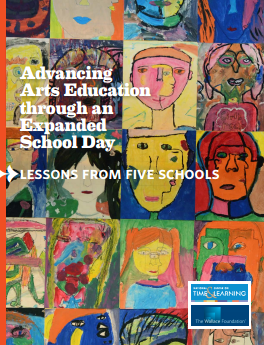
Today, NCTL and The Wallace Foundation are releasing Advancing Arts Education through an Expanded School Day: Lesson from Five Schools, which highlights schools that are finding ways to build a robust curriculum that integrates the arts without sacrificing the necessary time for other subjects, including literacy, mathematics, and science. By expanding learning time, these schools are able to design an educational program that sets high expectations for academic learning, including high-quality arts education.

Through a series of case studies the report explores how schools are utilizing the longer student and teacher days to prioritize time for arts education as they work to improve overall academic instruction and focus on individual student achievement.
“Education in the arts is more important than ever,” said Margo Lion, Co-Chair of the President’s Committee on the Arts and the Humanities. “To succeed at school and in the workforce, America’s children need to be creative thinkers and problem solvers. Arts education fosters those skills at a critical time in childhood development. We applaud schools like those featured in this report, which are taking the arts seriously and treating them as the tools for success that they are.”

A Dramatic Turnaround

For several years, we’ve told the story of the impressive change that has come about at the Edwards Middle School in Boston. Within a few years of adding 300 hours through the Massachusetts Expanded Learning Time Initiative in 2006, this middle school—once on the verge of being closed for its poor performance and declining enrollment—has become one of the top performing middle schools in the city. It also boasts a wide range of enrichment opportunities, including theater arts, step dancing and football, that students participate in for up to two hours every day.

As compelling as our storytelling is, however, nothing can communicate quite as directly and viscerally as film. I’m pleased to report that the Edwards story has now been captured in, I would venture to say, quite dramatic fashion by Edutopia. Now, I suppose this rendering of the Edwards story shouldn’t be surprising given the source. You see, Edutopia is a project of the George Lucas Educational Foundation, and when your benefactor has produced some of the most beloved films of all time, there is bound to be some penchant for dramatization, even with somewhat process-oriented subjects like school transformation.

From my perspective, what is most exciting about this project is not that the Edwards has gotten its due, however. Rather, it is that Edutopia, a significant player in the philanthropic world of education, has highlighted expanded learning time as one of its key strategies for school improvement. This foundation realizes that if schools hope to integrate technology and promote teacher learning and enable project-based learning, they will need more time than the conventional schedule allows.

The Common Core is Only the Beginning of How U.S. Schools Need to Change

This post by NCTL’s Co-Founder & President, Jennifer Davis, originally appeared in the Huffington Post.
In 1994, I was a part of the Clinton Administration team responsible for gaining Congressional approval and supporting the state implementation of the Goals 2000: Educate America Act — the education reform legislation that launched the standards movement. Twenty years later we finally have a set of rigorous and common math and English standards, the Common Core State Standards, adopted by 45 states. While these internationally benchmarked standards in two subjects represent a groundbreaking step forward, we cannot wait another twenty years for American schools to focus on the broader subjects and skills that are necessary to prepare students for success in our changing world.
The good news is that a number of education and philanthropic leaders are heading the charge to ensure students receive a richer, broader educational experience that includes the traditional core subjects together with the deeper learning skills that are essential in our 21st century economy. My organization, the National Center on Time & Learning, has just completed a study of five high schools that are a part of the Hewlett Foundation’s “deeper learning” school networks. Each school in these networks endeavors to instill a set of skills that will prepare students to navigate a future that will be dramatically different from today. While students in these schools gain a solid grounding of academic content, they also are expected to solve complex problems, think creatively, communicate effectively, present their work publicly and be independent learners. Indeed, they are assessed on their capacity to perform in these areas.
Massachusetts’ Codman Academy Charter School, for example, embraces just such a bold approach. The school serves a student body that is composed of a majority of high-poverty students (69 percent) and almost all (98 percent) students of color. Students attend school for up to 11 hours each day and for more days than the conventional school year because, in the words of the executive director, “We wanted to instill the habits of learning into as much our students’ lives as we possibly can.” And with this time, students can master core subjects, participate in internships, perform in major theatre productions, build critical thinking skills and become self-directed learners. Another school featured in our study, New Tech High School at Arsenal Tech in Indianapolis, has a student population that is more than 80 percent low income and boasts a technology-rich learning environment — including a one-to-one laptop to student ratio — exciting community internship opportunities and long interdisciplinary class periods designed to intensify learning through student-led projects.
As the networks of featured schools — EdVisions, Expeditionary Learning, High Tech High, Internationals Network for Public Schools, New Tech Network — demonstrate the promise of this new approach to teaching and learning, we must recognize that for more schools serving high-poverty students to incorporate these strategies they will need to add significantly more time to the school calendar. Our outdated school schedule of 180 6 ½-hour days simply does not give students the time they need to engage in the complex and multi-layered learning that are the linchpin of these new educational models, and it does not allow teachers the time to design new interdisciplinary curriculum and improve effectiveness through collaboration with peers.
Families that have resources are investing more than ever in opportunities that foster creativity, hands-on learning and connections to the broader world through technology and travel. Students from higher socioeconomic strata attend computer and science camps, take courses in specialized fields or have access to internships or apprenticeships through their personal networks of professionals. But, most often, low-income parents have neither the funds nor the connections to make these opportunities available. As such, our public schools must have the capacity and the mission to fill the gap. They must take the lead in providing students a 21st century education to climb out of poverty. Schools within the Hewlett Deeper Learning network are making great strides to achieve these aims, but such schools must be replicated and America must harness the power of time to furnish such education for all.

Little Differences, Big Differences

The other day, when listening to a news story on a recent research study, I was reminded of the famous short story by Ray Bradbury called “A Sound of Thunder.” In this science fiction narrative, time travelers are able to go back to the age of the dinosaurs to hunt and kill a Tyrannosaurus Rex, just minutes before the beast is about to become extinct. Before they leave, the travelers are warned not to wander from the path, lest even their tiny alterations to conditions in the pre-historic era somehow snowball to generate much larger changes millions of years later. Of course, such warning is unheeded by one of the story’s characters and he accidentally kills a butterfly in his wandering from the designated path. When the characters then return to their current time, the world they know is subtly, but dramatically different. An alternate course of history had been set simply with the demise of a single small creature.

So, what was this research study that brought this story to mind? Believe it or not, it was a study that examined how parents in three countries spent time differently with their young children, depending on if the child was a boy or girl. Overall, they found that parents spent equal amount of time with their children, regardless of gender, but that parents tended to spend more time with girls as young as 9 months old in activities that were more educationally-oriented, like going to libraries or reading to their child. The differences even showed up among parents of fraternal twins.

The authors of the paper then speculate that this subtle difference in the ways in which parents spend time with their very young children might—might!—be a reason why girls tend to perform better on math and reading assessments in primary grades. After they conduct an analysis to determine if such a correlation exists, they conclude:

boy-girl differences in parental inputs make some contribution to the corresponding differences in their preschool cognitive scores. While [these differences] are relatively modest, the tests are recorded at young ages, and so the impact may cumulate at older ages if learning deficits and advantages are cumulative.

In other words, small differences in the way that parents spend time with their very young children can potentially generate lasting (and even widening) gaps in learning as children wend their way through school. Without realizing it, the way parents spend their time, like the time travelers in Bradbury’s story, alters the course of their child’s history in subtle but still dramatic ways.

Now, on the one hand, this basic finding is nothing new. We’ve known for decades that children’s development at early ages has enduring consequences for their prospects in school and beyond. On the other hand, this study does augment the idea that environment and, very specifically, the ways in which children spend their time are partly responsible for the course of this development.

And what is true for childraising in the home surely has implications for educators, as well, the clearest of which is that time should be spent in ways that foster more learning and more curiosity about the world. If educators train their collective focus on this one point, our children will clearly benefit.

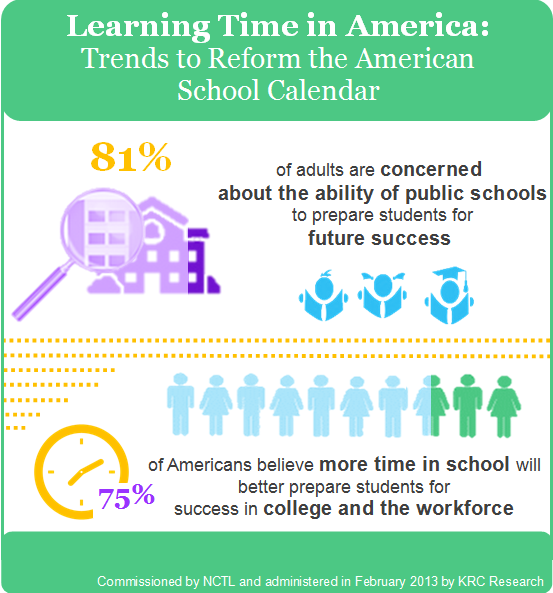
75% of Americans Say More Learning Time Will Help Prepare Students for Future Success

States and school districts around the country are making significant headway in their efforts to develop and implement innovative and cost-effective ways to improve schools through more and better learning time, according to a new report released today by NCTL and the Education Commission of the States. This new report looks at the movement since the release of the July 2011 report, Learning Time in America: Trends to Reform the American School Calendar, and includes results from a national survey showing broad support for expanding learning time through schools.


The report provides a comprehensive overview of policy developments at the federal, state, and district levels to enable and fund innovative school models with expanded time to close achievement and opportunity gaps. These policies are not only benefiting students, but providing teachers with time to collaborate and prepare for reforms, including Common Core implementation. The report also provides recommendations for policymakers at all three levels of government. Read the report here


Pages