TIME Collaborative School Mini-Profile: Teacher Collab & PD
By Lindsay Cyr on June 18, 2013 – 5:00am
The Senate Health, Education, Labor and Pensions Committee voted 12-10 today to pass the Strengthening America’s Schools Act, which would reauthorize the Elementary and Secondary Education Act (ESEA). The Strengthening America’s Schools Act builds upon many of the elements of the bipartisan 2011 reauthorization bill that also passed the Committee, while adding stronger accountability measures and taking into account the progress states have made since 2011 under the ESEA Flexibility Waivers issued by the Obama administration. (The 2011 bill did not get a vote in the full Senate.) This year’s version also made significant advances to promote more and better learning time by preserving existing and adding new expanded learning time provisions.
We are pleased to report that the bill includes language that will enable states and districts to continue using expanded learning time (ELT) as a whole-school reform strategy. First, it will provide greater flexibility in the 21st Century Community Learning Centers program, giving communities the ability to choose to use funding for high-quality expanded learning time in addition to before school, after school, and summer learning programs. This new flexibility would allow any district the option to choose expanded learning time, if it best suits its needs, as districts can in the 22 states have already responded to their districts’ interest in ELT by adding the program through their ESEA Flexibility Waivers.
Second, like the 2011 bill, the Strengthening America’s Schools Act writes into statute several school improvement models for the key program that targets the nation’s lowest-performing schools – the School Improvement Grant (SIG) program. The most important and frequently used models, Transformation and Turnaround, benefit greatly from the inclusion of “increased learning time” in the current regulations. Earlier versions of the statute would have taken increased learning time out of the requirements for the SIG program, but thanks to a crucial amendment by Senator Kay Hagan (NC) and cosponsored by Senator Elizabeth Warren (MA), this important element of the SIG program was added to the statute.
Over 1,000 schools serving more than 520,000 students in 36 states and the District of Columbia are expanding learning time. Orchard Gardens K-8 Pilot School, once a struggling school in Boston, MA, became a SIG school in 2009. By effectively increasing learning time and implementing other key turnaround strategies, the school has undergone a dramatic turnaround. Thanks to Senator Hagan’s amendment, the law will support current SIG schools as they build on this progress, and it will help ensure that new applicants benefit from using increased learning time as a comprehensive strategy for school reform.
NCTL wants to applaud Chairman Harkin (IA) for his longstanding leadership on expanded learning time, and Senators Hagan and Warren for their passionate advocacy for ELT schools in North Carolina, Massachusetts, and throughout the nation. The bill must now move to the full Senate for a vote before it can be conferenced with the House’s ESEA reauthorization bill, which is scheduled for a hearing and amendments next week. We’ll continue to track ESEA’s reauthorization progress through Congress and what it means for expanding learning time on this blog.
For several years, we’ve told the story of the impressive change that has come about at the Edwards Middle School in Boston. Within a few years of adding 300 hours through the Massachusetts Expanded Learning Time Initiative in 2006, this middle school—once on the verge of being closed for its poor performance and declining enrollment—has become one of the top performing middle schools in the city. It also boasts a wide range of enrichment opportunities, including theater arts, step dancing and football, that students participate in for up to two hours every day.
As compelling as our storytelling is, however, nothing can communicate quite as directly and viscerally as film. I’m pleased to report that the Edwards story has now been captured in, I would venture to say, quite dramatic fashion by Edutopia. Now, I suppose this rendering of the Edwards story shouldn’t be surprising given the source. You see, Edutopia is a project of the George Lucas Educational Foundation, and when your benefactor has produced some of the most beloved films of all time, there is bound to be some penchant for dramatization, even with somewhat process-oriented subjects like school transformation.
From my perspective, what is most exciting about this project is not that the Edwards has gotten its due, however. Rather, it is that Edutopia, a significant player in the philanthropic world of education, has highlighted expanded learning time as one of its key strategies for school improvement. This foundation realizes that if schools hope to integrate technology and promote teacher learning and enable project-based learning, they will need more time than the conventional schedule allows.
The other day, when listening to a news story on a recent research study, I was reminded of the famous short story by Ray Bradbury called “A Sound of Thunder.” In this science fiction narrative, time travelers are able to go back to the age of the dinosaurs to hunt and kill a Tyrannosaurus Rex, just minutes before the beast is about to become extinct. Before they leave, the travelers are warned not to wander from the path, lest even their tiny alterations to conditions in the pre-historic era somehow snowball to generate much larger changes millions of years later. Of course, such warning is unheeded by one of the story’s characters and he accidentally kills a butterfly in his wandering from the designated path. When the characters then return to their current time, the world they know is subtly, but dramatically different. An alternate course of history had been set simply with the demise of a single small creature.
So, what was this research study that brought this story to mind? Believe it or not, it was a study that examined how parents in three countries spent time differently with their young children, depending on if the child was a boy or girl. Overall, they found that parents spent equal amount of time with their children, regardless of gender, but that parents tended to spend more time with girls as young as 9 months old in activities that were more educationally-oriented, like going to libraries or reading to their child. The differences even showed up among parents of fraternal twins.
The authors of the paper then speculate that this subtle difference in the ways in which parents spend time with their very young children might—might!—be a reason why girls tend to perform better on math and reading assessments in primary grades. After they conduct an analysis to determine if such a correlation exists, they conclude:
boy-girl differences in parental inputs make some contribution to the corresponding differences in their preschool cognitive scores. While [these differences] are relatively modest, the tests are recorded at young ages, and so the impact may cumulate at older ages if learning deficits and advantages are cumulative.
In other words, small differences in the way that parents spend time with their very young children can potentially generate lasting (and even widening) gaps in learning as children wend their way through school. Without realizing it, the way parents spend their time, like the time travelers in Bradbury’s story, alters the course of their child’s history in subtle but still dramatic ways.
Now, on the one hand, this basic finding is nothing new. We’ve known for decades that children’s development at early ages has enduring consequences for their prospects in school and beyond. On the other hand, this study does augment the idea that environment and, very specifically, the ways in which children spend their time are partly responsible for the course of this development.
And what is true for childraising in the home surely has implications for educators, as well, the clearest of which is that time should be spent in ways that foster more learning and more curiosity about the world. If educators train their collective focus on this one point, our children will clearly benefit.
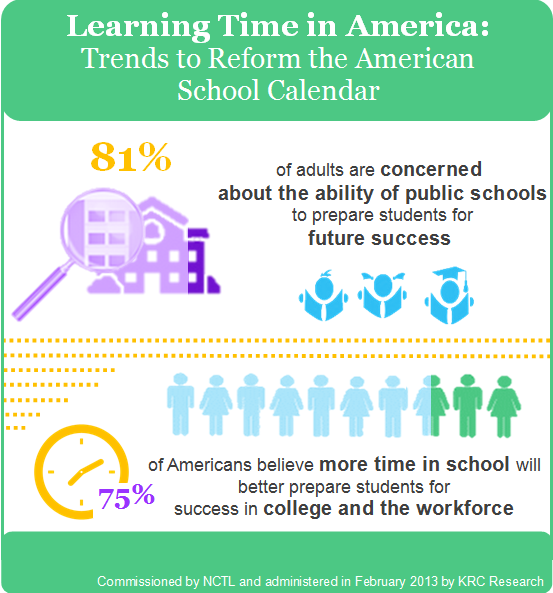
States and school districts around the country are making significant headway in their efforts to develop and implement innovative and cost-effective ways to improve schools through more and better learning time, according to a new report released today by NCTL and the Education Commission of the States. This new report looks at the movement since the release of the July 2011 report, Learning Time in America: Trends to Reform the American School Calendar, and includes results from a national survey showing broad support for expanding learning time through schools.